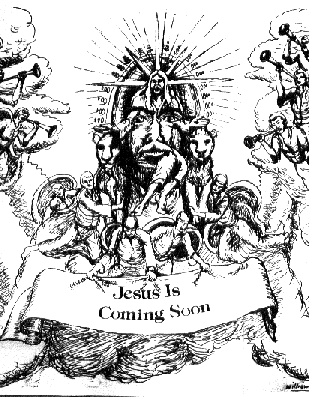
"I will shake the heavens, and the earth, and the sea, and the dry land; And I will shake all nations, and the desire of all nations shall come: and I will fill this house with glory, saith the LORD of hosts." (Hag 2:6-7)
We discussed the situation in Russia last time and how the current political instability sets the stage for Russia's participation in the Ezekiel 38 invasion of Israel. Since then, Lebed has been sacked as National Security Chief for plotting a coup against Yeltsin. Lebed said: "I was an obstacle to plans by Chubais (Chief of Staff) to set up a regency. He wants to become President. The main reason is that two days ago I sent to the President results of my investigation into who was to blame for Chechnya. I was a black sheep. It was only a matter of time before they sacked me. I am not part of their herd."
He indicated that he will only continue to seek the presidency using legitimate means: "I call on my comrades in arms, my allies and people who I probably do not know in person...do not do anything abrupt, we act only using constitutional means." However, if history is any teacher, the ambitious Lebed will be preparing as best he can for both a constitutional and an unconstitutional route to the presidency. A Lebed-led coup cannot be ruled out. Meanwhile, Yeltsin's health remains an issue as he recovers from heart bypass surgery.
It is a far more dangerous time then most people realize.
"For thus saith the LORD of hosts; Yet once, it is a little while, and I will shake the heavens, and the earth, and the sea, and the dry land; And I will shake all nations, and the desire of all nations shall come: and I will fill this house with glory, saith the LORD of hosts." (Hag 2:6-7)
"Watch therefore, and pray always that you may be counted worthy to escape all these things that will come to pass, and to stand before the Son of Man." (Luke 21:36)
Iraq is in the news again. The United States is waging war with Saddam Hussein for the second time since 1991. Hussein is the ruler of Iraq, a Middle Eastern country with a rich history of prophetic significance.
Iraq's land mass is roughly equivalent to what was known in ancient times as Mesopotamia (meaning the land between two rivers, the Tigris and the Euphrates). Mesopotamia was once regarded as the cradle of civilization. Around 4,000 B.C., the Sumerian culture was the first to cultivate land, use calendars, and create the first written alphabet. The famous Sumerian city, Ur of the Chaldees, was located in Iraq. It was out of Ur that God called Abraham. After the collapse of the Sumerian civilization, the people reunited under King Hammurabi of Babylon, in 1700 B.C. Following his death, the country was ruled by Assyria for about two centuries. It was then restored to its former glory by Nebuchadnezzar II, who built the famous hanging gardens of Babylon and made Babylon the most famous city in the ancient world.
It is of prophetic significance that Saddam considers himself to be Nebuchadnezzar III, and has spent billions of dollars restoring the city of Babylon, which is located about 60 miles south of Baghdad. The city was untouched during Desert Storm. A future Babylon, however, will be destroyed through God's judgment during the tribulation period (Rev. 14, 16, 17, 18). Whether this historic city is the Babylon that will ultimately be destroyed by God, or whether "Mystery Babylon" (Rev 17:5) has not yet been revealed, is a discussion for another time.
Modern Iraq's fall from grace began on August 2, 1990 when, as the culmination of a long-standing territorial dispute, Iraq invaded Kuwait. The U.N. Security Council condemned the Iraqi occupation, demanding complete withdrawal by January 15, 1991. Iraq failed to comply.
So just after midnight on January 17, 1991, operation "Desert Storm" commenced. Aircraft from 28 nations followed a barrage of cruise missiles into Iraqi airspace. When it was over just four weeks later, Saddam Hussein's chemical and nuclear facilities were destroyed, Kuwait had been liberated, Israel had sustained 39 Scud-missile hits, and Iraq suffered the death of thousands. American soldiers returned home victorious, only to later experience the ravages of Gulf War Syndrome.
By early 1992, it became apparent that Iraq still possessed weapons of mass destruction, so U.N.-imposed sanctions were ordered. In 1993, the U.N. maintained these sanctions, in spite of Iraq's attempts to have them lifted.
The motivation for this latest attack is not as easily justified as it was in 1991, given that the Kuwait invasion of 1990 was a clear violation of international law. At that time, the U.S. had no problem putting together a coalition of nations under U.N. control to right the wrong and liberate Kuwait. However, this time the circumstances were different. Apparently Baghdad's military action within its own territory was motivated by strategic national interest -- to safeguard its oil pipelines and fields from the encroaching Iranians and their Kurdish supporters.
According to press reports, Iran was backing the Patriotic Union of Kurdistan against the Kurdish Democratic Party in an attempt to control the Iraqi oil installations in northern Iraq. There were also reports of penetration of Iraq's northeastern borders by the Iranian Revolutionary Guards. This action by Iran was interpreted by some as a move to dictate terms regarding war reparations from Iraq before U.N. resolution 986 (oil-for-food) commenced. Ahmad Shaker, in a report to "The Star", an Arab newspaper (September 12 edition), sums up the situation from an Arab perspective: "Diplomatic and U.N. reports suggested that Tehran's aims were to back Talbani's forces (Patriotic Union of Kurdistan) in their fight against Massoud Barzani's Kurdish Democratic Party in order to control Iraqi oil installations in the north in addition to the main crossing border points into Turkey and Iran."
Talbani's forces had already defeated Barzani's Kurds in the Seydi area. That defeat prompted Iran to talk openly about its role in northern Iraq. Its Foreign Minister, Ali Akbar Vellayati, boasted that "only Iran can implement peace in northern Iraq."
Tehran was relying on two important facts; first, that Iraqi President Saddam Hussein was too weak to intervene militarily; and second, that even if he wanted to intervene, he would risk a strong U.S. reprisal.
What was Washington doing to confront the Iranian threat? For one thing, it was trying -- in vain -- to bring the two Kurdish factions to the negotiating table. When that attempt failed, the U.S. was confronted with the new reality in the north imposed by Saddam Hussein.
The U.S. reprisal has unfortuntely helped Iraq. Saddam Hussein not only regained direct control of the north, kicking out Iranians and over-running Talbani's forces, but the missile attack (which some feel was aimed primarily at helping President Clinton in his bid for re-election in November) fractured the U.S.-led anti-Saddam alliance.
It appears that U.S. support from its allies in the region was also fractured. The action was met with condemnation not only by predictable sources such as Libya, but also from European allies such as France and Spain. The action has drawn condemnation from the Arab League for infringing on the sovereignty of an Arab country.
This action could have adverse effects for Israel as Arab support coalesces against the United States. Consider Saudi Arabia, which refused to allow the U.S. to use its land to launch attacks against Iraq. American presence is only tolerated when it serves their best interests. This action may well limit our future ability to be a stabilizing force in the Middle East,calling into question America's ability to guarantee "peace and security" to Israel.
"Intelligence Digest" (Sept. 6, 1996 issue, 1-800-237-8400, ext. 76), in discussing the wider implications of this action and its effect on maintaining long-term regional stability, points out that the U.S. has been arguing "that Israel can afford the risk of a full territorial retreat from the Golan Heights and the West Bank because it will always be protected by American military might. The Israelis are not so certain. Former Prime Minister Shimon Peres might have agreed, but the new Likud government believes that America's will to protect Israel could, in certain circumstances, be undermined -- by international opposition and the threat of terrorism on the U.S. mainland."
This is the crux of the matter. As a result of this action, the United States has lost support in this area and possibly placed itself in the future position of being denied access to foreign land-based military assets. The U.S. might prove to be the real loser in this latest conflict with Iraq.
Ezekiel 38:13 tells us that the U.S. will only mass what amounts to a diplomatic protest to the Russian-led Muslim invasion of Israel. As a result of this action against Iraq, we may have come one step closer to making Ezekiel 38:13 a reality -- especially given that unrest in Russia, the faltering of the peace process, and perhaps greater Arab unity in the future, may be the catalysts to ignite the Ezekiel 38 invasion.
How has the United States put themselves in this position? After all, "Desert Storm I" was a victory for George Bush and the "New World Order" crowd. They had successfully garnered military support from 28 nations under the banner of the United Nations --the future one-world army. This was an opportunity to further their cause for one-world government, which the Globalists have targeted for implementation by the year 2000.
George Bush's approval rating skyrocketed after this successful military action. Unfortunately, Bush peaked too soon and was defeated in the 1992 election. This, of course, begs the question: What part has politics played in this latest military action?
The foreign press, as quoted above, certainly recognizes the potential political motivation for U.S. action against Iraq. It may be that Russia had a hand in precipitating this action. Is it coincidence that Zhirinovsky, who has been referred to by Saddam Hussein as a "special and life-long friend", visited Baghdad just before the Iraqi crisis broke out? Is it possible that Russia encouraged Saddam to take this action as bait to draw Clinton into a pre-election show of his leadership ability?
Clearly, Russia has been supportive of Iraq's position and has been pushing Washington and its Western European allies to lift crippling post-war sanctions against Baghdad. This may be, in part, because Iraq owes Russia massive debt which Iraq is not able to pay out of its squeezed oil revenues. Russia also issued a particularly strong condemnation of the attack, saying: "The government of the Russian Federation sees the American military operation as an inappropriate and unacceptable reaction [to the latest events in northern Iraq] and a threat to its sovereignty." U.S. strikes against Iraq were also met with angry remarks by Lebed, who accused Clinton of carrying out the attacks to boost his image. "This is the essence of true democracy -- carry out air raids and then gather the journalists to applaud," said Lebed.
Meanwhile, ultra-nationalist Zhirinovsky said "Napoleon and Hitler are children compared to Clinton. Clinton is worse then Hitler. The U.S. action is bullying on a planetary scale. For an election victory, Clinton is ready to burn a few more capitals." What role might Zhirinovsky, who has the support of the Russian Missile Forces and who has threatened to "nuke" America, play if a new hawkish government emerges in Russia?
Watch Russia.
These events are all occurring at the same time the United States is moving away from God. If you have studied the three-part series entitled: "What in Heaven is Happening to America?" and the discussion on Ezekiel 38 and 39 contained in the seven-part series on Israel, you should understand how all three topics in this newsletter are related. In the final analysis, America may prove to be "the other country that lives in the safety of the far distant coast lands" that is judged by God along with Russia at the time of the Israeli invasion (Eze 39:6).
Pray for America. The United States is not exempt from God's wrath. We will reap what we sow. Judgment is at hand. Be sure your trust is in the Lord and not in the things of this world, for soon, everything that can be shaken will be shaken. Only those that have truly built their house upon The Rock will survive.
Remember two things: 1) God is in control. ``He changes times and seasons; He sets up kings and deposes them. He gives wisdom to the wise and knowledge to the discerning.'' (Dan 2:21) God is in control, not Russia or any other nation. And: 2) God knows how to preserve His people while reserving sinners for judgment.
Deaths mount in the Middle East as Israeli and Palestinians forces clash. The fighting has been going on for about two days over Israel's decision to open a tunnel next to an important Moslem shrine in Jerusalem's Old City. In this latest uprising, 33 Palestinians and 10 Israeli soldiers were killed and hundreds wounded as the fighting raged across the West Bank and the Gaza strip. The Islamic Jihad group called on its fighters to attack Israeli targets, and peace negotiations were broken off.
Israeli officials contacted Arafat in Gaza in an attempt to halt the protests. Arafat replied: "The most important thing that we cannot accept is the Judaization of Jerusalem. East Jerusalem is our capital and has been occupied since 1967." Arafat canceled a scheduled Israeli-Palestinian meeting on the implementation of the Oslo accord.
In response to the ongoing violence, Israel declared a state of emergency. They sent in tanks, helicopters, and extra troops as they attempted to quell the violence. This was the first time tanks had been used since 1967. Meanwhile, the U.S., France, Britain and other nations appealed for calm. But Arafat's Palestinian Authority urged Arab states to isolate and punish Israel. This sounds like an invitation to an Ezekiel 38 invasion!
The United States is continuing to apply intense diplomatic pressure to calm this violence and salvage the peace process. If Netanyahu caves in to the pressure and breaks his campaign promises not to compromise on Israel's security, Israel will again be on the road to concessions. This will eventually lead to a position where their only defense will be through the use of nuclear weapons.(2)
If Netanyahu does not cave in, even greater violence will erupt from the 36,000 armed Palestinian police in the West Bank and Gaza strip. Israel will have no choice but to forcibly put down this violence, inviting military action from Syria and other Arab states.(2) Jerusalem is certainly becoming the "burdensome stone" for the whole world predicted by Zachariah 12:2. "The burden of the word of the LORD for Israel, saith the LORD, which stretcheth forth the heavens, and layeth the foundation of the earth, and formeth the spirit of man within him. Behold, I will make Jerusalem a cup of trembling unto all the people round about, when they shall be in the siege both against Judah and against Jerusalem. And in that day will I make Jerusalem a burdensome stone for all people: all that burden themselves with it shall be cut in pieces, though all the people of the earth be gathered together against it." (Zec 12:1-3)
Watch Israel, watch Jerusalem, and watch Syria.
"The burden against Damascus. "Behold, Damascus will cease from being a city, and it will be a ruinous heap." (Isaiah 17:1)
The Israeli Defense Force has continued to monitor unusual troop movements in Syria. Syria has apparently pulled troops out of Lebanon and has built positions in the demilitarized zone of the Golan Heights -- a violation of the 1974 disengagement agreement between Israel and Syria.
Relations between Syria and Israel have been disintegrating for months over Netanyahu's oppositions to the land-for-peace formula in negotiations with the Arabs. Syria wants Israel to return all the lands it holds on the strategic Golan Heights. Where former Israeli Prime Minister Shimon Peres and his predecessor, Yitzhak Rabin, had expressed willingness for at least a partial Golan withdrawal, Netanyahu sees this as compromising Israel's security.
Reuters News Service reported that a senior Jordanian diplomat said on October 25 that Syria is preparing for a surprise military attack on Israel in the coming weeks, just before the U.S. president is sworn in. The Syrians believe that, during the post-election period, the U.S. administration will not be ready to dispatch forces to the Middle East. He also revealed that there has been high-level contact between Syrian and Jordanian military officers. Syria has gone so far as to ask the Jordanians to conduct military maneuvers next to their border with Israel to force the IDF to move troops from the Golan Heights, so Syria can establish a bridgehead on the Golan. Syria's objective is apparently to force Israel to accept a total withdraw from the Golan Heights.
With reference to the possibility of a new Syrian-Israeli military conflict in the Middle East, Jordan's King Hussein said (at a joint press conference with French President Jacques Chirac): "I certainly hope and pray that would not be the case, and I don't see any reason why it should. I hope we will see progress toward the implementation of agreements already reached between the parties concerned ... this is our hope and I think war is not in the mind of anyone." A French official in Chirac's entourage, which met with Syrian President Hafez Assad for 14 hours during the last week of October, said that Chirac got the impression from his talks with Assad that Syria wants peace and that for Syria, peace represents not only a wish but a strategic interest. However, the French official added, getting back the Golan is a precondition for the Syrians. Assad reportedly told Chirac that if Syria gets back the Golan, the nature of peace and security arrangements would be negotiable (October 25, 1996 Reuters News Service).
Again we are seeing serious saber-rattling in the Middle East, with talk of peace and security in the offering. Someday, possibly very soon, the anti-Christ is going to step up and guarantee Israel peace by confirming a previous peace covenant...possibly the September 13, 1993 Agreement. However, it is possible that this peace guarantee will be made after the nuclear exchange in the Ezekiel 38 invasion, or perhaps after Syria and Israel go to war. Time will tell.
If Syria does invade, their capital of Damascus may well "cease from being a city, and become a ruinous heap." (Isaiah 17:1) Meanwhile, the Egyptian army is currently conducting its largest maneuvers since the Yom Kippur War, including simulated sea landings at the Red Sea port of Safagah. And in Iran, Rafsanjani is preparing for new war games, code-named: "Tariq al Quds" -- "The road to Jerusalem."
Clearly, as Daniel prophesied in Daniel 12, things are starting to accelerate. We are hurtling toward an appointment with destiny. God help those who have not accepted Jesus Christ as Lord and Savior. Pray for them and prepare yourselves to meet your God.
References:
Intelligence Digest, Oct. 11&26, 1996, 1-800-237-8400, ext #76 Reuters News Service, October 25, 1996
"Prophecy and Current Events" is a bi-monthly newsletter published by: "To His Glory
Ministries" All rights reserved, but permission is
hereby granted to copy and distribute for non-commercial purposes only. Consider copying and
distributing to friends, relatives, pastors, or church congregation. Gifts of support are used to offset
personal expense in providing this newsletter.

To His Glory Ministries is not a tax-exempt organization.
"Now, brothers, about times and dates we do not need to write to you, for you know very well that the day of the Lord will come like a thief in the night. While people are saying, "Peace and safety," destruction will come on them suddenly, as labor pains on a pregnant woman, and they will not escape. But you, brothers, are not in darkness so that this day should surprise you like a thief. You are all sons of the light and sons of the day. We do not belong to the night or to the darkness. So then, let us not be like others, who are asleep, but let us be alert and self-controlled. For those who sleep, sleep at night, and those who get drunk, get drunk at night. But since we belong to the day, let us be self-controlled, putting on faith and love as a breastplate, and the hope of salvation as a helmet." (1TH 5:1-8)
Remember Jesus is returning for a Holy and Spotless Bride.
Maranatha!

 Return Home
 Click Here to send EMail
to:To His Glory
Click Here to send EMail
to:To His Glory